
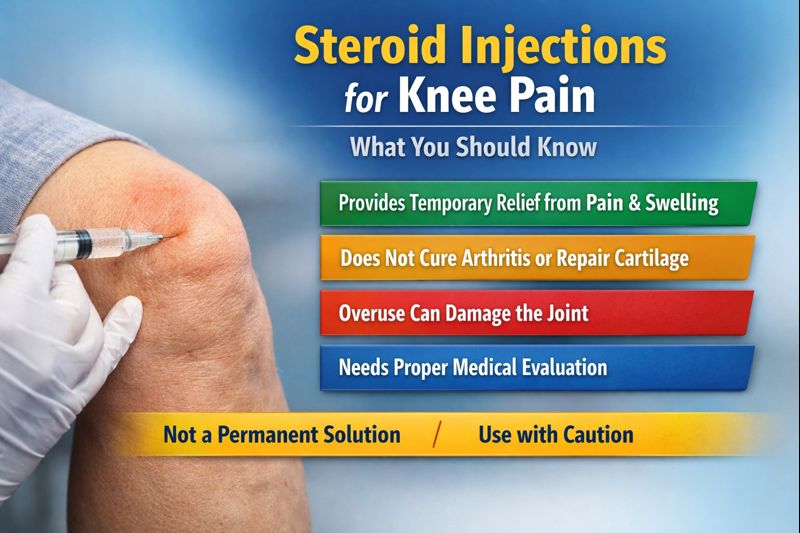
Most people don’t wake up one day with severe knee pain. It usually starts quietly. A little stiffness when getting out of bed. Discomfort while climbing stairs. Pain after a long walk that didn’t bother you before. Over time, these small problems add up, and daily life starts to feel harder.
That’s often when someone mentions a steroid injection for knee pain.
And naturally, the questions follow:
Is it safe? Will it cure the problem? Should I take it or avoid it?
Let’s clear the confusion and talk about steroid injections in a simple, honest way.
What a Steroid Injection Really Does
A steroid injection contains cortisone, a medication that reduces inflammation. When injected directly into the knee joint, it works on swelling and irritation inside the joint.
Inflammation is what causes most of the pain, stiffness, and tightness in the knee. When inflammation goes down, pain usually follows. Movement feels easier. Walking becomes more comfortable.
What the injection does not do is fix the root damage. It doesn’t rebuild cartilage. It doesn’t reverse arthritis. It doesn’t permanently “heal” the knee.
This is where many misunderstandings begin.
Why Doctors Suggest Steroid Injections
Doctors don’t usually suggest injections for mild knee pain. They’re recommended when pain starts affecting daily life.
In practice, injections are considered when:
- Pain limits walking, standing, or sleep
- Swelling does not settle with medicines
- There is a sudden worsening of arthritis pain
- Surgery is not immediately required
In knee arthritis treatment, steroid injections are mainly used to control symptoms during difficult phases. Think of them as a temporary support, not a final solution.
When Steroid Injections Help the Most
Steroid injections work best during flare-ups periods when pain suddenly increases and movement becomes difficult.
They are most helpful when:
- Pain increases suddenly
- Swelling is clearly present
- Stiffness limits bending or straightening the knee
In early to moderate arthritis, patients often get good short-term relief. In advanced arthritis, where cartilage is already badly worn, the benefit may be limited.
This doesn’t mean the injection “failed.” It simply means the problem has progressed beyond inflammation alone.
How Long Does the Relief Last?
This is one of the most common questions.
Some people feel better in two or three days. Others take a week. Relief can last a few weeks or sometimes a few months. Eventually, the effect wears off.
A steroid injection for knee pain is not meant to be repeated frequently. Too many injections can weaken cartilage and harm the joint over time. That’s why timing matters.
Relief is temporary. And it’s meant to be used thoughtfully.
Risks and Side Effects: What Patients Should Know
When used correctly, steroid injections are generally safe. Still, patients should be aware of possible issues.
These can include:
- Temporary increase in pain for a day or two
- Rare risk of joint infection
- Temporary rise in blood sugar (important for diabetics)
- Cartilage weakening if injections are overused
Good knee pain management is about reducing pain without creating future problems. That balance is important.
The Role of Injections in Knee Arthritis Treatment
Steroid injections do not cure arthritis. Arthritis is a long-term condition. No injection can stop it completely.
In knee arthritis treatment, injections are used to:
- Reduce pain during bad phases
- Improve short-term movement
- Delay surgery when appropriate
In real practice, injections are often used to buy time time to stay active, time to plan, and time to decide the next step carefully.
They are helpful, but they are not the whole plan.
Thinking Long-Term About Knee Pain
Effective knee pain management always looks beyond immediate relief.
Long-term care may involve:
- Reducing excess load on the knee
- Adjusting daily activities that strain the joint
- Regular medical follow-up
- Considering surgery when pain and damage become severe
A steroid injection for knee pain can fit into this plan, but it should never be the only strategy.
Patients who understand their condition usually do better. They make calmer, smarter decisions.
Final Words
A steroid injection for knee pain is neither something to fear nor something to rely on blindly. It’s a medical option useful when used at the right time, and harmful when overused.
In knee arthritis treatment and knee pain management, the goal is not just pain relief. It’s preserving movement, independence, and quality of life for as long as possible.
Clear understanding leads to better outcomes.
And good treatment always starts with honest information.
Questions Patients Commonly Ask
Is a steroid injection safe?
Yes, when used appropriately and not too often.
Will it cure my knee arthritis?
No. It controls symptoms but does not repair damage.
How many injections can I take?
Usually limited to a few per year to protect the joint.
Will pain relief be immediate?
Relief usually starts within a few days.