
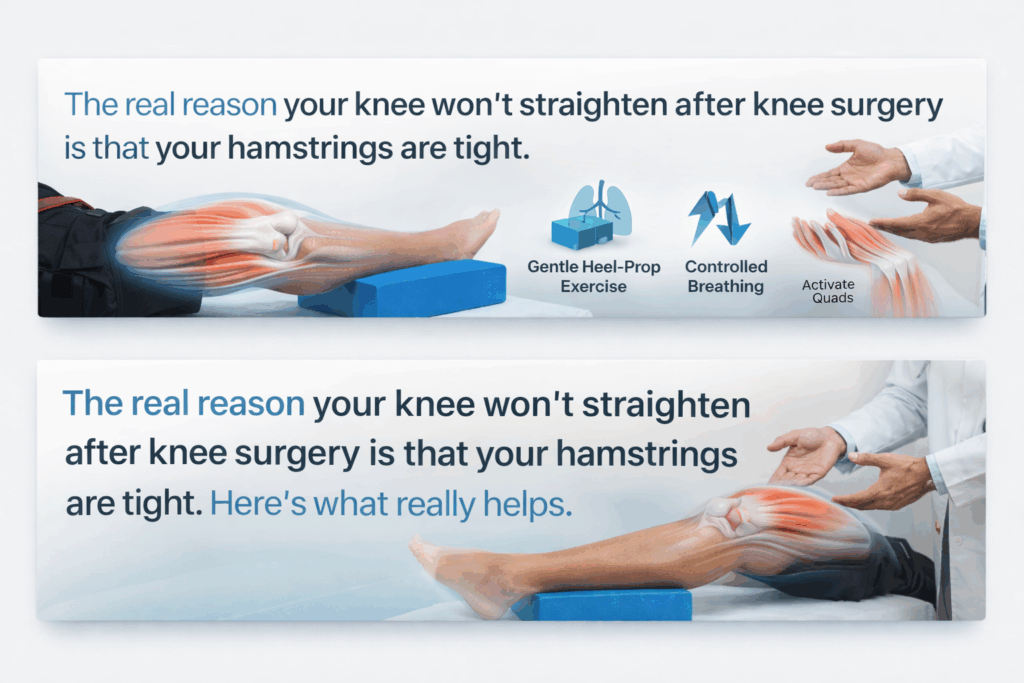
Tight hamstrings after knee surgery are one of the most common reasons patients struggle to fully straighten their knee during recovery.
You’re not the only one who has had knee surgery and feels like your leg won’t fully straighten. After surgery, one of the most common things people say is that their hamstrings feel tight. Patients often ask, “Is something wrong?” Is my graft not working? Did I miss a key time for rehab?
Here’s the truth: tight hamstrings after knee surgery are usually a good thing, not a bad thing. But knowing why they get tight, how that affects knee extension, and what really helps can make the difference between a quick recovery and long-term stiffness.
Let’s make it simple and easy to understand.
Why Tight Hamstrings After Knee Surgery Are So Common
Tight hamstrings after knee surgery develop as part of the body’s natural protection response to pain, swelling, and surgical trauma.
After knee surgery, whether it’s ACL reconstruction, ligament repair, or even arthroscopy, the body goes into protection mode right away.
Pain, swelling, and surgery can cause muscles to react reflexively. One of the first muscles to respond? The hamstrings.
They get tighter to protect the joint. This is the body’s way of saying, “Let’s keep this area safe.”
The problem isn’t the tightness itself. The problem happens when this protective tension lasts too long and starts to mess with how the knee works normally.
Understanding tight hamstrings after knee surgery helps patients focus on safe rehabilitation instead of aggressive stretching that can delay recovery.
Protective Tension: The Body’s Natural Way of Staying Safe
Hamstrings are very important for controlling knee movement, especially when the knee is straightening. After surgery, they automatically raise the tone to stop sudden or too much movement.
This tension that protects:
- Limits full extension of the knee
- Gives a sense of resistance or stiffness
- The leg feels “stuck” when it is slightly bent.
This is not scar tissue in most early cases, which is important. It’s a reaction of the nerves and muscles.
Knowing this changes how rehab should be done.
The main cause: an imbalance between the quad and hamstring
This is where a lot of rehab programs go wrong.
The quadriceps get a lot weaker after surgery, sometimes within days. Just swelling can stop them. The hamstrings take over when the quads can’t do their job and keep the knee stable.
What happened?
- Hamstrings get too much work
- The knee is bent.
- Getting full extension becomes harder.
This quad-ham imbalance is one of the main reasons why people lose the ability to extend their knees after ACL surgery.
If you stretch your hamstrings too much without fixing your weak quads, it can backfire.
Why losing the ability to extend your knee is a big deal
A lot of patients work on bending their knees more and more. Flexion feels useful. People don’t pay attention to extension.
That’s wrong.
Not being able to fully extend your knee can cause:
- Strange ways of walking
- More stress on the patellofemoral joint
- Chronic pain in the front of the knee
- Early tiredness and instability
- Wear and tear on cartilage over time
In clinical practice, the early and safe restoration of extension is a significant predictor of favourable outcomes.
What really helps tight hamstrings after surgery
Managing tight hamstrings after knee surgery requires restoring muscle balance rather than forcing flexibility too early.
This is where being clear is important.
The goal is not to make the hamstrings relax. The goal is to lower the protective tone and bring back normal mechanics.
1. Gentle Heel-Prop Workouts
Low-load, gravity-assisted extension lets the nervous system relax slowly. No pushing. No pain chasing.
2. Breathing in a controlled way
Deep, slow breathing calms the sympathetic nervous system, which directly lowers muscle tone. People often don’t realise how powerful this is.
3. Activate the quad before stretching.
When the quadriceps start to work right, the hamstrings don’t have to protect as much. This balance is very important for recovering from knee surgery.
4. Consistency over intensity
It’s better to do small, frequent stretches than to try to stretch a lot all at once.
What to Stay Away From in Early Recovery
This is just as important as knowing what to do.
Don’t:
- Stretching the hamstrings hard
- Pushes that hurt to extend
- “No pain, no gain” ideas about rehab
- Not paying attention to swelling control
Stretching too aggressively too soon can make guarding worse, make stiffness worse, and slow down recovery.
What Surgeons and Specialists Look at First
Before moving on to more advanced exercises, skilled surgeons look at a few important things:
- Stability of the graft
- Levels of swelling
- Control of the straight-leg raise
- How well the quad contracts
It only makes sense to move on to loading and flexibility work after these are taken care of.
Restoring extension safely is better for the long-term health of your knees than rushing range of motion.
A Real-Life Clinical Insight
In clinical settings, tight hamstrings after knee surgery are frequently seen when quad activation is delayed or rehabilitation focuses too aggressively on stretching.
In real life, I often see patients who are months after surgery and still can’t fully extend. This isn’t because they didn’t get rehab; it’s because it was too aggressive in the wrong direction.
When we stop thinking about “stretching harder” and start thinking about “restoring balance and control,” progress often happens quickly. Sometimes in just a few weeks.
That’s what sets targeted recovery apart from generic rehab.
Loss of Knee Extension After ACL Surgery and Post Knee Surgery Rehabilitation
Loss of knee extension after ACL surgery can be worrying, especially when you feel like you’re doing everything right but the knee still refuses to straighten fully. Most people immediately think something has gone wrong. That the graft isn’t holding. Or that they missed an important rehab window. In reality, that’s rarely the case. More often, the knee is still guarding itself. Swelling may still be present, the muscles are staying tense, and the quadriceps simply haven’t started working normally again.
This is where post knee surgery rehabilitation really shows its value. Recovery usually improves when things are slowed down instead of pushed harder. Gentle work on extension, keeping swelling under control, and gradually re-engaging the quadriceps allow the knee to feel safe again. Progress doesn’t come from forcing movement. It comes from consistency and timing. When rehab respects how the body heals, extension often returns quietly sometimes without you even noticing at first.
The Bottom Line
After knee surgery, tight hamstrings are not a bad thing.
They mean something.
This means that your body is protecting itself and that your rehab plan needs to be precise, not forceful.
Focus on safe stretching, getting your quad back to normal, and following the healing timeline, and the stiffness should go away.
When rehab works with biology instead of against it, recovery goes more smoothly, safely, and predictably.
Questions that people often ask
Many patients search online about tight hamstrings after knee surgery because stiffness and difficulty straightening the knee can feel alarming during recovery.
Is it normal for your hamstrings to be tight after ACL surgery?
Yes. It’s a common and expected reaction after surgery.
How long does it take for tight hamstrings to go away?
It depends, but most patients see improvement within weeks not months if they do the right rehab.
Can tight hamstrings hurt the graft?
Yes, in a way. If you keep your knees bent, it can change how they work and put stress on the structures around them.
Should I stretch my hamstrings every day after surgery?
Only lightly, and only as part of a balanced rehab plan that focusses on activating the quads and controlling their extension.
 Understand Your Knee Recovery