
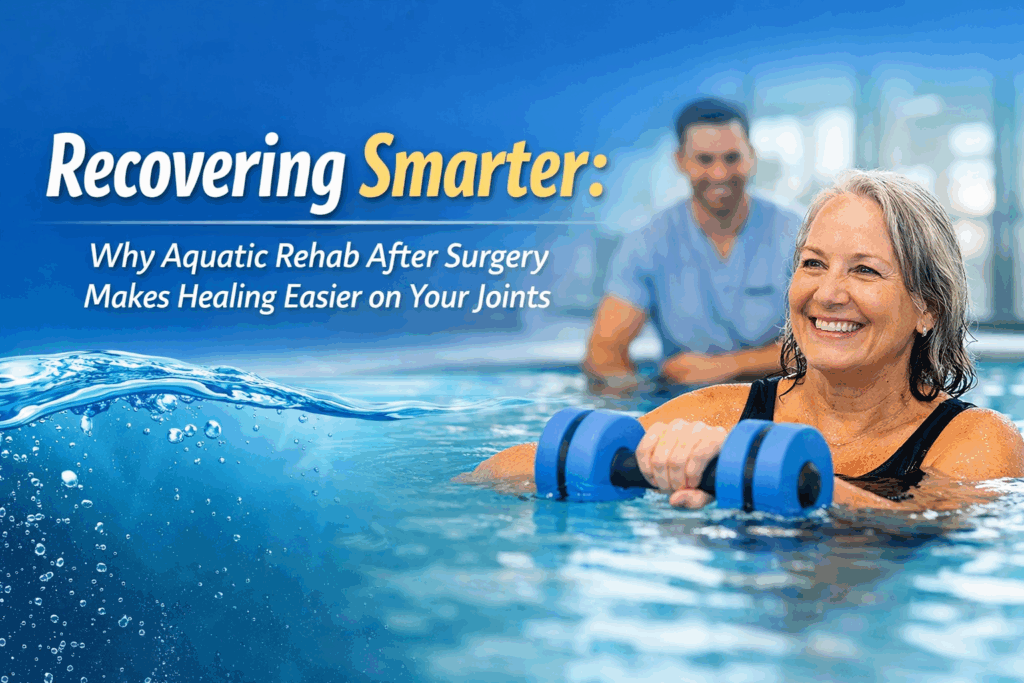
Recovering Smarter: Why Aquatic Rehab After Surgery Makes Healing Easier on Your Joints
Aquatic rehab after surgery is something I often recommend to patients who feel stuck between wanting to recover and being afraid to move. After an operation, most people believe the safest thing they can do is rest completely. Stay off the leg. Avoid bending. Don’t stress the joint.
It sounds logical but in reality, too much rest can slow your healing more than help it.
Your body doesn’t recover through stillness alone. It recovers through safe, gradual movement. That’s exactly why water-based exercises have become such a powerful tool during post surgery recovery.
Because sometimes, the problem isn’t movement itself it’s gravity.
The Phase Nobody Warns You About
Surgery is only half the journey.
The harder part often comes after.
The days when the stitches are healing but your joint feels stiff…
When your muscles feel weak…
When even getting out of bed feels like a task…
And then there’s the mental side.
What if I damage the repair?
What if it swells again?
What if the pain gets worse?
These thoughts are incredibly common. I hear them every day in my clinic. Patients want to move, but fear holds them back.
That hesitation is natural. But avoiding movement completely leads to tighter joints, weaker muscles, and a longer road to recovery.
This is where aquatic rehab after surgery changes the experience entirely.
Why Water Feels Like Freedom
The first time patients step into a therapy pool, they almost always say the same thing:
“Doctor, it feels so light.”
And that’s exactly the point.
Water supports your body weight. Depending on the depth, your joints may only carry 30–40% of the usual load. Suddenly, standing feels easier. Walking feels smoother. Bending doesn’t hurt as much.
Movements that felt impossible on land feel manageable in water.
That small difference builds huge confidence.
During aquatic rehab after surgery, you’re not fighting your body you’re working with it.
Gentle, Yet Surprisingly Effective
Some people think water therapy is “too easy” to make a difference.
It’s actually the opposite.
Water provides natural resistance in every direction. Even slow movements activate muscles. Without heavy weights or strain, your legs and hips start rebuilding strength safely.
This balance is exactly what good orthopedic rehabilitation aims for not too little, not too aggressive, just steady and controlled progress.
And that’s why many patients progress faster than they expect.
Less pain means better participation.
Better participation means better results.
What Recovery Looks Like in Real Life
In theory, rehab sounds clinical. But in real life, it’s deeply personal.
It’s being able to walk to the kitchen without holding the wall.
Climbing stairs without hesitation.
Sleeping through the night without throbbing pain.
Feeling like yourself again.
I’ve seen patients who could barely take a few steps on land walk comfortably for 15–20 minutes in water during their first aquatic rehab after surgery session.
That moment changes everything.
Because once they realize they can move safely, fear starts disappearing.
And confidence speeds up post surgery recovery more than any medicine.
Who Should Consider Pool-Based Rehab?
While almost anyone can benefit, aquatic rehab after surgery is especially helpful for:
- Knee replacement patients
- Hip surgery recovery
- ACL or ligament repairs
- Meniscus procedures
- Sports injuries
- People with higher body weight or severe pain
If walking feels heavy or uncomfortable, water gives you a softer starting point.
It allows you to stay active without punishing your joints which is exactly what smart orthopedic rehabilitation should do.
What Actually Happens During a Session?
A lot of people imagine swimming laps.
That’s not necessary at all.
Most sessions are simple and controlled.
You might walk slowly across the pool, practice gentle squats, lift your leg with support, or work on balance. Nothing extreme. Nothing rushed.
The goal isn’t exhaustion it’s improvement.
The idea is to leave the pool feeling better than when you entered, not sore or discouraged.
Consistency beats intensity every time during post surgery recovery.
The Hidden Benefit: Trusting Your Body Again
Here’s something textbooks rarely mention.
Recovery isn’t only physical. It’s emotional.
After surgery, people lose trust in their own body. They treat their joint like glass, afraid it might break.
But once they start aquatic rehab after surgery, something shifts.
They realize:
I can walk.
I can bend.
I’m stronger than I thought.
That mental shift is powerful. Because when fear goes down, movement goes up. And when movement goes up, healing accelerates.
It’s a positive cycle.
The Importance of Post Surgery Recovery
A well-planned post surgery recovery process plays a crucial role in restoring strength, mobility, and confidence after any orthopedic procedure. Instead of complete rest, guided and gradual movement helps reduce stiffness, improve circulation, and protect healing tissues. With proper care and supervision, patients can recover safely, minimize complications, and return to their daily activities stronger and pain-free.
Orthopedic Rehabilitation for Safe and Effective Recovery
Orthopedic rehabilitation plays a crucial role in helping patients regain strength, mobility, and confidence after surgery or injury. It focuses on guided exercises, pain control, and gradual movement to protect healing joints while restoring function. With a structured plan, patients recover faster and reduce the risk of stiffness or complications. A well-supervised orthopedic rehabilitation program ensures a safer return to daily activities and an active, pain-free life.
Final Thoughts
Surgery fixes the structure. Rehabilitation restores function.
If you’re in the middle of healing, don’t think of recovery as “rest until better.” Think of it as “move safely to get stronger.”
Aquatic rehab after surgery offers exactly that a safe space to rebuild strength, mobility, and confidence without overloading your joints.
Healing doesn’t have to feel painful or intimidating.
Sometimes, all it takes is stepping into the water and realizing your body is capable again.
And that’s when true recovery begins.