After a successful ACL reconstruction, you feel both relieved and determined the day you leave the hospital. You’ve gotten through the first big problem. But as the weeks turn into months, a lot of athletes and people who like to work out notice something strange: the leg that had surgery looks like a shadow of its former self. No matter how many squats you do, that “gap” in muscle size and strength stays the same.
Getting back to normal muscle symmetry after ACL surgery is often harder than the surgery itself. To be successful in the long run, you need to stop thinking “no pain, no gain” and learn how our brains talk to our muscles.
The science behind the “shrinking” leg
When the knee joint is hurt or operated on, the central nervous system tells the muscles around it to “turn off” to protect it. This is useful for the first 48 hours, but after that, it makes rehab harder. If you don’t fix this neural shutdown, you could spend hours in the gym without building muscle because the fibres aren’t “firing,” which makes it almost impossible to get muscle symmetry back after an ACL injury.
The Trap of Moving to Make Up for It
People are very good at making up for things. When one limb is weak, our bodies automatically move the weight to the stronger side. You might think you’re doing a perfect squat, but a biomechanical analysis often shows that the healthy leg is doing 70% of the work.
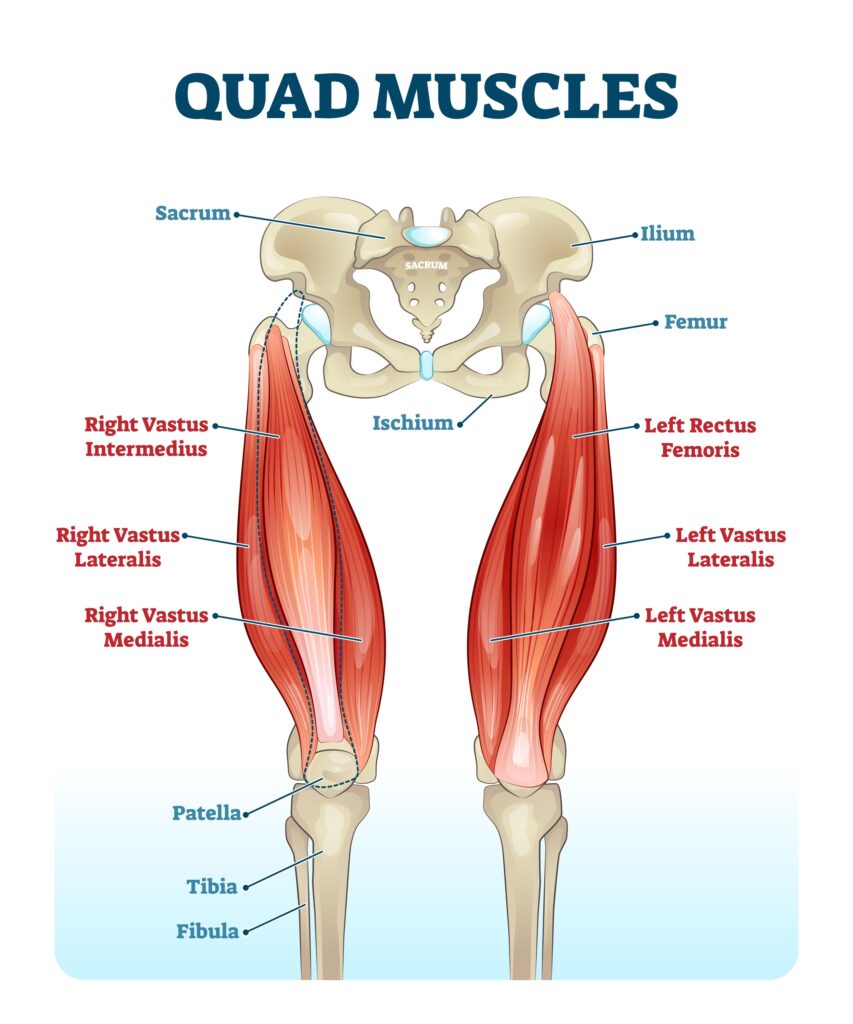
This is why traditional two-legged training doesn’t always help people get their quadriceps strength back after surgery or help with muscle symmetry during ACL recovery. If you keep squatting or pressing with both legs, your stronger side will keep “bullying” your weaker side, which will make the asymmetry worse and could lead to back pain or hip problems later on.
Breaking the Cycle with One-Sided Training
To really close the gap and master ACL recovery muscle symmetry, you have to make the leg that had surgery stand on its own. This is when single-leg exercises are the best way to go for ACL rehab.
If you isolate a weak limb, you can’t make up for it. It helps the brain fix the neural pathways that surgery messed up, which is important for the muscle symmetry that comes with ACL recovery. But there is a right way and a wrong way to do this.
1. Control Before Load
People often make the mistake of trying to lift heavy things too soon. If you try to do a single-leg press with weight that you can’t control, your body will use “cheat” muscles, like the glutes or lower back, to move the weight. To get your ACL recovery muscle symmetry back, you need to learn the “slow and steady” way. Pay attention to how your brain and muscles work together. Do you feel the teardrop muscle (VMO) working? If not, lower the weight.
2. The Power of “Quality Over Quantity”
I always tell the athletes I work with that twenty perfect reps are better than a hundred sloppy ones. When your form breaks down, you are no longer training for muscle symmetry after an ACL injury; you are training for injury.
Making a Plan for Your Symmetry
If your quadriceps are weak after surgery, you should start your workout with one-sided movements when your nervous system is fresh. This will help your ACL recovery muscle symmetry.
- For split squats: hold the weight in the middle and don’t let your knee bend in.
- Single-leg extensions: are a great way to work out your quad, but only if your doctor says it’s okay.
- Step-Ups: The “eccentric” phase, which is the way down, is where most muscle growth and control happen for ACL recovery muscle symmetry.
Adding these single-leg exercises to your plan makes sure that the leg that had surgery can’t hide anywhere. You are not only gaining muscle mass, but also “neural confidence,” which is how willing your brain is to let that leg carry your whole body and restore muscle symmetry after ACL surgery.
The Mental Block: Putting Your Trust in the Limb
Being physically symmetrical isn’t enough. The other half is in your mind. Many patients have trouble with muscle symmetry after ACL surgery because they don’t want to hurt the area where the surgery took place. This fear makes them walk slowly and have a “guarding” reflex.
As an orthopaedic surgeon, I’ve seen that the best recoveries happen when the patient goes from “protecting the limb” to “challenging the limb.” This change needs to be made by a professional who can objectively measure how well your ACL recovery muscle symmetry is going. We don’t guess when a leg is ready for high-impact sports; we use strength tests and functional movement screens to find out.
When to Ask a Professional for Help
You need to change your rehab plan if you still feel like you’re walking with a “hitch” six months after surgery or if your operated thigh is more than 2 cm smaller in circumference than the other thigh.
After an ACL injury, it takes a long time to get your muscles back to being symmetrical. It takes time, effort, and a lot of knowledge about how the body works. You don’t have to deal with “uneven” legs for the rest of your life. You can fully recover from an ACL injury and get back to the field, court or gym stronger than you were before.
Final Thoughts
Everyone has to follow the same rules of biology, but your path to recovery is different. If you want to fix your ACL recovery muscle symmetry, stop hiding behind moves that use two legs. Try the challenge of working out one leg at a time. Don’t let your brain’s natural defences keep you from reaching your full potential.
Dr. Mayank Daral is an Olympic Certified Orthopaedic Surgeon who focusses on sports injuries and complex knee reconstruction. He wants to help athletes get from surgery to elite performance through rehabilitation that is based on evidence.