
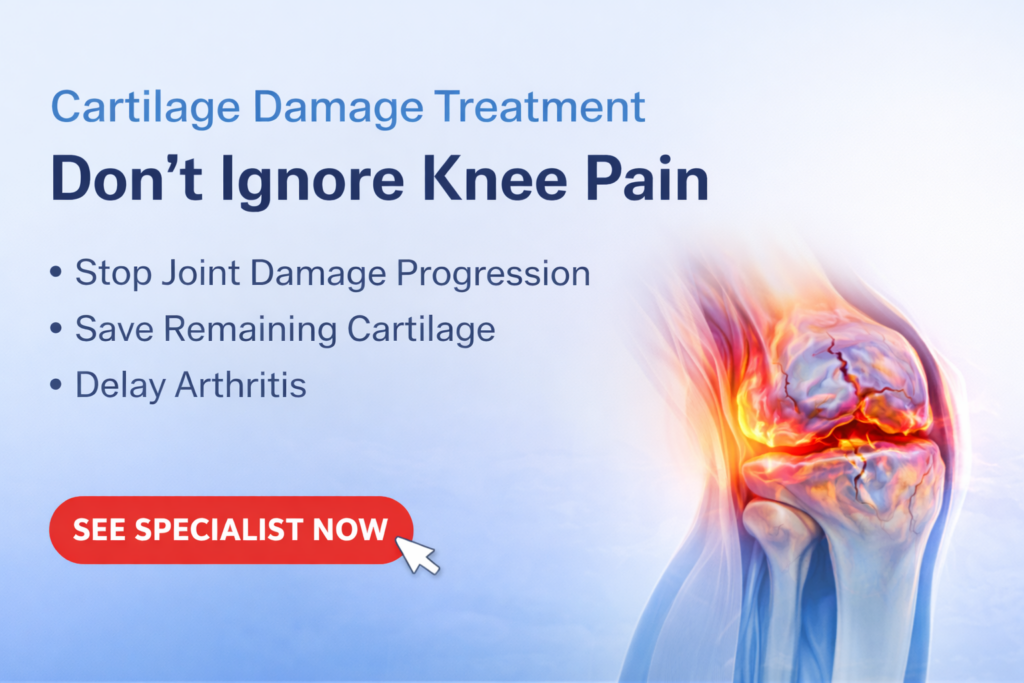
Cartilage Damage: The Silent Reason Behind Your Knee Pain
Cartilage Damage Treatment is most effective when the problem is detected early and managed by an orthopaedic specialist.
Not every knee problem starts with an injury.
In fact, most of the patients I see don’t remember twisting their knee or falling. There’s no accident. No dramatic moment. Just a slow, nagging discomfort that shows up one day and never really leaves.
A little stiffness in the morning.
Pain while climbing stairs.
A heavy feeling in the knee after walking.
Most people ignore it.
They assume it’s age. Or weakness. Or just overuse.
But very often, the real culprit is something much quieter — cartilage damage.
And the tricky part? It progresses silently.
What Exactly Is Cartilage (And Why Does It Matter So Much)?
Persistent knee pain often indicates the need for proper Cartilage Damage Treatment.
Let me explain this simply.
Inside your knee joint, the ends of your bones are covered with a smooth, slippery layer called cartilage. Think of it like a natural cushion or shock absorber.
It helps your knee:
- Move smoothly
- Absorb impact
- Prevent bones from rubbing together
When cartilage is healthy, you don’t even notice your joints. Movement feels effortless.
But when that cushioning starts wearing down, every step begins to feel different.
And once cartilage is damaged, the body doesn’t repair it easily. That’s why protecting it early is so important.
Why Cartilage Damage Is Called “Silent”
Early diagnosis helps determine the right Cartilage Damage Treatment before arthritis develops.
Here’s something I tell my patients all the time:
Cartilage damage doesn’t scream. It whispers.
Early on, symptoms are so mild that people brush them off.
You might notice:
- Slight stiffness after sitting
- Discomfort after long walks
- Occasional knee pain without injury
- A tight or heavy feeling in the joint
Nothing alarming.
So you carry on with life.
Meanwhile, the cartilage slowly continues to thin.
By the time pain becomes regular, the joint has already lost some of its natural protection.
When the Knee Starts Sending Stronger Signals
Modern Cartilage Damage Treatment focuses on preserving joint health, not just reducing pain.
As cartilage wears down further, the knee can’t glide smoothly anymore. Bones begin to take more stress than they’re meant to.
That’s when people start saying:
“Doctor, now it hurts every day.”
Common symptoms at this stage include:
- Pain while climbing stairs
- Stiffness in the morning
- Swelling after activity
- Grinding or clicking sounds
- Reduced movement
This is usually when patients finally decide to get checked — and often we find early degeneration or the beginning of arthritis.
How Cartilage Damage Slowly Leads to Arthritis
Cartilage loss isn’t sudden. It’s gradual.
It usually happens like this:
First, cartilage softens.
Then it thins.
Then cushioning reduces.
Then bones start rubbing.
Then inflammation begins.
Over time, this becomes arthritis.
That’s why early arthritis prevention really starts much earlier — when cartilage damage is still small and manageable.
Once arthritis is established, treatment becomes more complicated.
Catching it early makes life much easier.
Who Should Pay Attention to These Signs?
Honestly? Almost everyone.
Cartilage damage isn’t only an “older person’s issue” anymore.
I see it in:
- Young athletes
- Gym-goers
- Working professionals
- People who sit long hours
- People who stand long hours
You don’t need a big injury.
Sometimes it’s just years of stress adding up.
If your knee keeps bothering you without a clear reason, it deserves attention.
Why Early Evaluation Makes a Big Difference
This is something I’ve seen repeatedly in my practice.
Patients who come early usually recover faster and avoid bigger problems.
When cartilage issues are detected early:
- Joint damage can be slowed
- Pain can be managed properly
- Function can be preserved
- Surgery can often be avoided or delayed
But when someone waits years… options become limited.
It’s really that simple.
Early action = better outcomes.
Modern Cartilage Damage Treatment: Focus on Protection, Not Just Pain
Good cartilage damage treatment isn’t just about taking painkillers.
Pain relief alone doesn’t protect your joint.
The real goal is:
- Reduce stress on the knee
- Control inflammation
- Preserve remaining cartilage
- Prevent further degeneration
Depending on the case, treatment may involve medical management, joint-supporting therapies, or specialized orthopaedic procedures when required.
The idea is always the same — save the joint, not just silence the pain.
A Conversation I Often Have With Patients
Many people tell me,
“Doctor, I thought it would go away on its own.”
I gently remind them:
Joint pain is your body’s warning light.
You wouldn’t ignore a warning light in your car for months. Your knee deserves the same respect.
Listening early can save you years of discomfort later.
Final Thoughts: Don’t Normalize Knee Pain
Timely Cartilage Damage Treatment can slow damage and protect long-term mobility.
Some soreness after heavy activity is normal.
But regular pain, stiffness, or reduced movement isn’t something you should accept as “just aging.”
Your joints are meant to last a lifetime.
And small steps today — early diagnosis, timely care, proper guidance — can protect them for years to come.
If your knee keeps bothering you, even without injury, don’t ignore it.
Getting it checked early might be the smartest health decision you make.